What Makes 48% Smarter Location Planning Possible with Zepto Dark Store Data Tracking in India?
Introduction
India’s quick commerce boom is reshaping how brands, retailers, and investors evaluate market expansion. This is where Zepto Grocery Delivery Data Scrapingbecomes valuable, helping businesses understand how Zepto is scaling its infrastructure across high-demand zones and emerging city clusters.
Many decision-makers struggle to predict which areas can support a new warehouse model, which pin codes show strong repeat ordering behavior, and where delivery-ready demand is growing faster than supply. When brands monitor Zepto Dark Store Data Tracking in India, they gain actionable insights into where Zepto is investing and how its quick commerce presence is shifting across urban and semi-urban markets.
From new city launches to cluster-based fulfillment coverage, tracking dark store movement enables sharper retail strategies and smarter partnerships. Ultimately, this intelligence supports better distribution planning, improved inventory decisions, and faster go-to-market execution in India’s fast-moving grocery delivery ecosystem.
Why Expansion Decisions Fail Without Visibility?
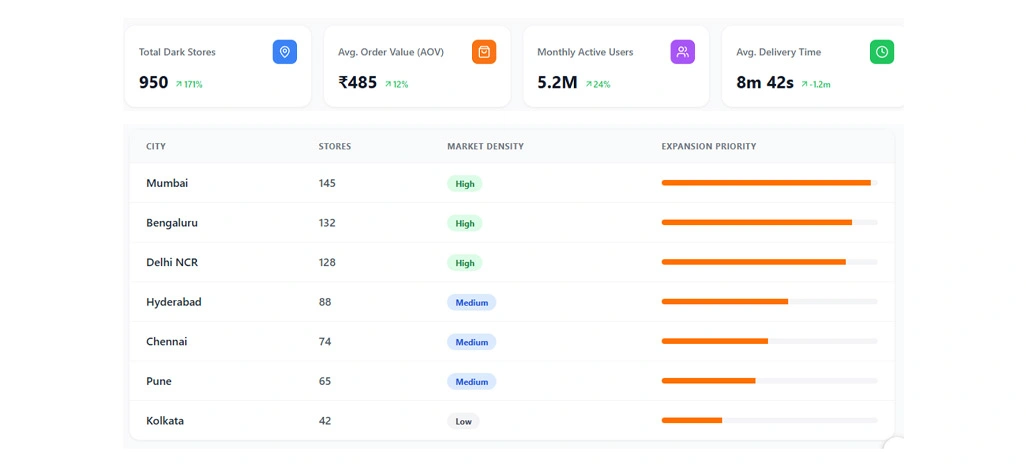
Without reliable dark store intelligence, many brands enter quick commerce markets with incomplete information. In India’s fast-paced grocery market, even a minor location mistake can increase operational costs, reduce delivery efficiency, and delay customer adoption.
A smarter approach is to Track Zepto Dark Store Locations and monitor how infrastructure is being deployed across high-performing zones. When brands observe the patterns behind Grocery Delivery Warehouse Locations, they gain clarity on which micro-markets are receiving investment and which are being ignored.
This also helps teams understand the density logic behind the Zepto Delivery Network, revealing how the company clusters warehouses for faster service reach. Businesses using Zepto API Data Scraping Solutions can automate this expansion monitoring and avoid manual tracking delays.
Key Expansion Problems vs Smart Planning Fix:
| Expansion Issue | Business Risk | Data-Based Planning Solution |
|---|---|---|
| Wrong locality selection | Higher delivery cost | Competitor location monitoring |
| Low service feasibility | Poor customer retention | Dark store density mapping |
| Slow expansion visibility | Missed growth zones | Automated infrastructure updates |
| Over-investment in saturated areas | Reduced ROI | Cluster-based store comparison |
In addition, using Quick Commerce Dark Store Mapping supports better competitive benchmarking and ensures expansion plans are based on actual market movement rather than outdated assumptions.
Fixing Delivery Coverage and Reach Blindspots
Many retailers struggle because they cannot accurately define which zones are truly deliverable within quick commerce timelines. To solve this, teams rely on Real-Time Zepto Store Location Tracking to monitor store additions and detect network growth signals in active markets.
This supports smarter forecasting because brands can see which clusters are consistently being served and which remain underserved. With deeper visibility into Zepto Serviceable Area Data, decision-makers can evaluate whether an area has genuine fulfillment support or only partial coverage.
Many businesses use structured models to Identify Zepto Serviceable Areas Automatically, helping them validate market readiness before investing in partnerships or warehouse planning. This becomes even more effective when combined with Real-Time Zepto Grocery Price Scraper, which connects location coverage trends with real-time pricing activity, improving demand prediction accuracy.
Service Coverage Challenges and Solution Outcomes:
| Coverage Challenge | Impact on Expansion | Solution Benefit |
|---|---|---|
| Unknown deliverable pin codes | High delivery failure | Faster feasibility validation |
| Limited visibility into coverage shifts | Missed market timing | Real-time store monitoring |
| Incorrect service boundary assumptions | High operational loss | Automated service area mapping |
| Poor cluster planning | Low order repeat rate | Smarter zone-based targeting |
By monitoring how the Zepto Delivery Network is expanding, brands can identify fulfillment gaps and avoid launching campaigns in zones that are not yet fully supported.
Building City-Level Growth Strategy with Data
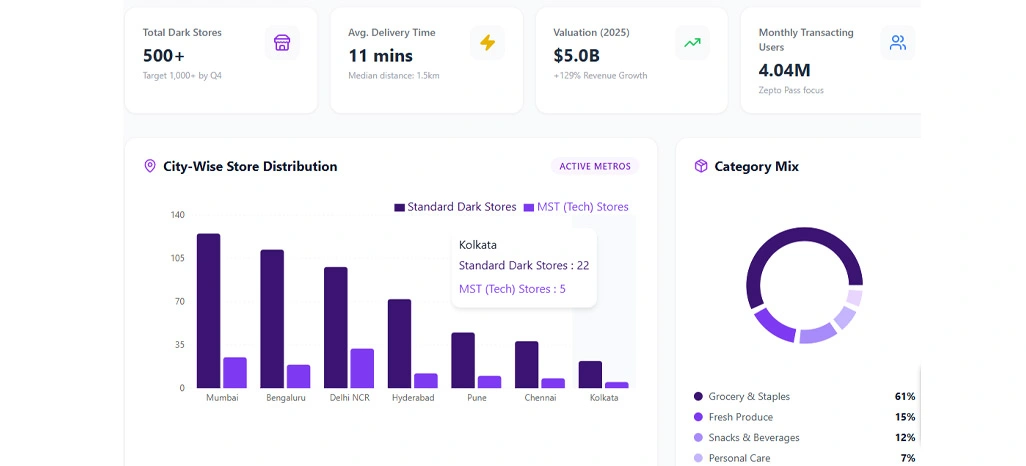
Quick commerce growth across India is uneven, and not every city expands at the same speed. Some metros show rapid warehouse launches, while others grow slowly through small cluster additions. Using Zepto City-Wise Store Analysis helps decision-makers understand which cities are gaining more fulfillment infrastructure and which locations show strong operational momentum.
It also supports better forecasting by showing where demand is likely rising, based on how store density and coverage zones evolve. When brands compare city movement through Zepto Dark Store Expansion Analysis, they can identify high-growth opportunities and avoid saturated clusters.
Businesses also benefit from How to Track Zepto Dark Store Locations in India, as it provides a structured approach to monitor store additions, service coverage updates, and competitor growth patterns. With access to Zepto Grocery Store Datasets, companies can maintain consistent tracking across multiple cities and build predictive expansion strategies.
City Growth Signals and Business Applications:
| City Growth Signal | What It Indicates | Business Use Case |
|---|---|---|
| Rising store density | Growing customer demand | Expansion targeting |
| Increasing coverage clusters | Faster delivery feasibility | Warehouse placement |
| Frequent store additions | Aggressive scaling strategy | Competitive benchmarking |
| Stable infrastructure zones | Mature market presence | Long-term planning |
This approach also improves planning accuracy by highlighting areas where competitor infrastructure investment is accelerating. Ultimately, data-backed city expansion reduces risk, strengthens ROI, and supports smarter fulfillment deployment decisions.
How Retail Scrape Can Help You?
In today’s fast-moving grocery delivery market, relying on assumptions is costly. When teams apply Zepto Dark Store Data Tracking in India, they can evaluate market gaps, monitor infrastructure growth, and predict future fulfillment movement more accurately.
How we supports your growth:
- Provides structured datasets for faster location-based decision-making.
- Helps monitor expansion activity across multiple urban clusters.
- Enables competitive benchmarking using store footprint visibility.
- Supports demand-based planning through service reach validation.
- Improves go-to-market timing using market movement indicators.
- Reduces operational risk by validating coverage availability.
For brands planning distribution and partnerships, Real-Time Web Scraping Services ensure faster access to competitor movement trends and store-level expansion insights.
Conclusion
Quick commerce success depends on selecting the right locations, at the right time, with the right infrastructure signals. When businesses analyze Zepto Dark Store Data Tracking in India, they gain deeper clarity into where demand is rising and where fulfillment investments are being made, leading to sharper and more confident expansion planning.
At the same time, tracking Grocery Delivery Warehouse Locations helps brands compare competitive infrastructure density and reduce expansion risk in high-cost urban zones. Connect with Retail Scrape today and start building a data-backed growth roadmap.