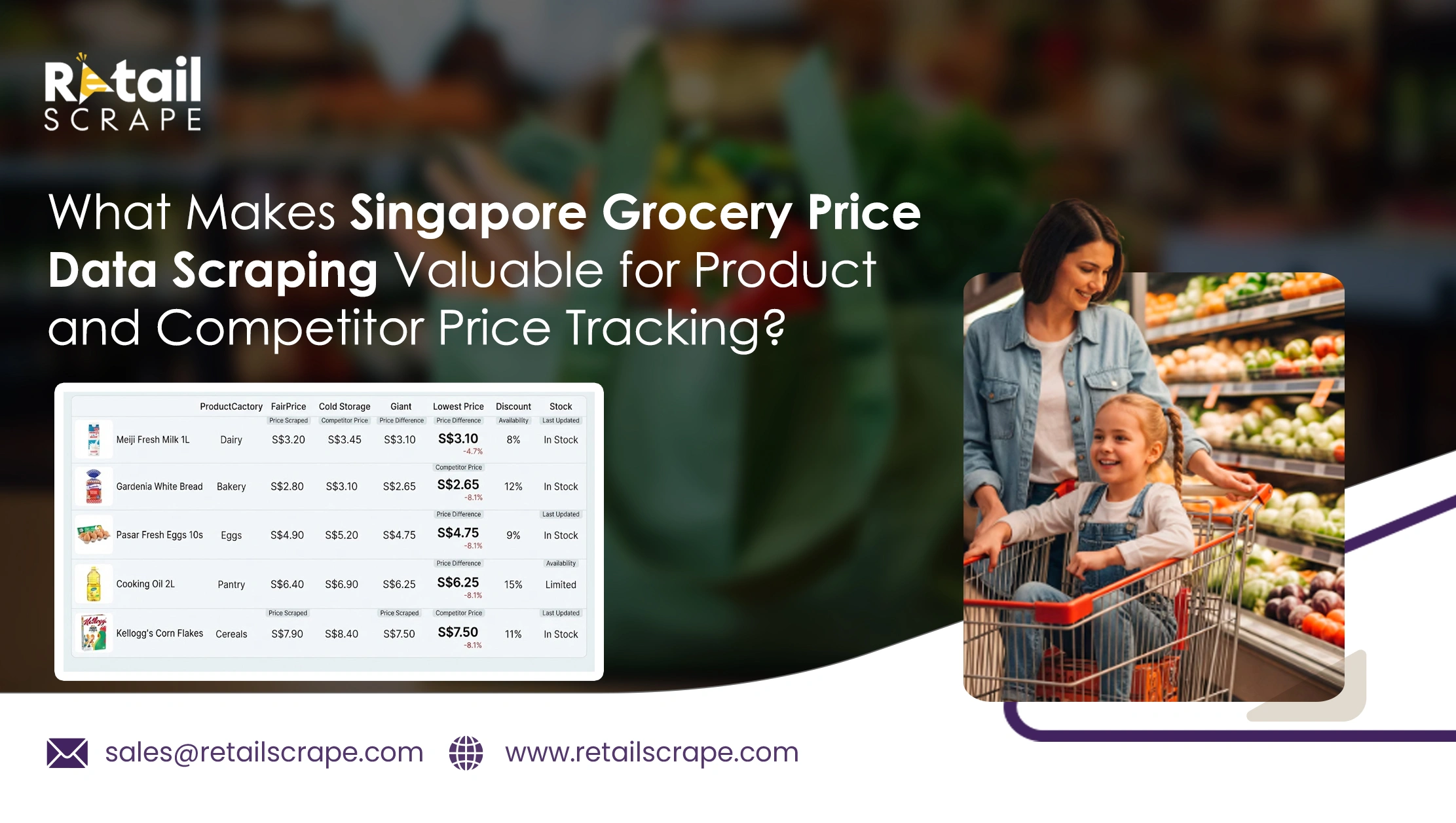
What Makes Singapore Grocery Price Data Scraping Valuable for Product and Competitor Price Tracking?
Introduction
Singapore's grocery market is highly competitive, with supermarkets and online retailers frequently adjusting product prices, discounts, availability, and promotional offers. Singapore Grocery Price Data Scraping gives businesses a structured way to collect this information across multiple retail sources, helping them understand pricing movements and competitive positioning more consistently.
Manual monitoring becomes increasingly difficult when retailers manage thousands of products across different categories and brands. Automated collection can organize product names, prices, pack sizes, discounts, availability, and related attributes into structured datasets. This makes recurring analysis more efficient while reducing the effort involved in repetitive price checks.
Reliable grocery data can also help businesses identify pricing gaps, promotional patterns, and changing customer-facing offers. By analyzing historical and current records together, retailers can evaluate market movements, improve assortment decisions, refine pricing strategies, and respond more effectively to changes within Singapore's competitive grocery environment.
Stronger Pricing Visibility Across Singapore Grocery Markets
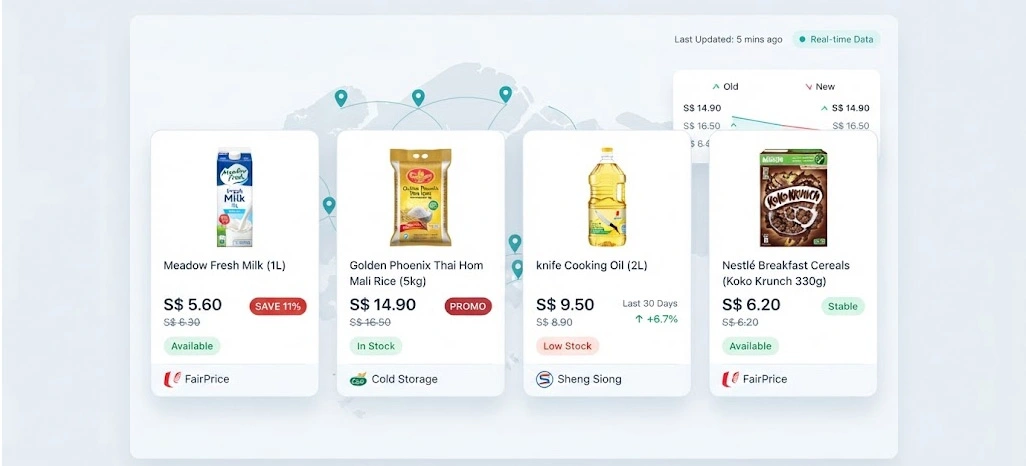
Price visibility plays an important role in understanding how grocery products perform across a competitive retail environment. Retailers need consistent information to identify changes in listed prices, promotional offers, product availability, and pack sizes. Instead of relying on occasional manual checks, structured data collection can create recurring records that make pricing movements easier to review. This approach also gives category teams a clearer view of which products are changing frequently and which remain relatively stable.
A reliable Singapore Grocery Price Tracking process can help businesses observe pricing patterns across selected grocery sources. When thousands of products are reviewed regularly, teams can identify repeated price movements and compare historical observations with newer records. This can support better category planning and help businesses understand where competitive adjustments may be occurring. It also creates a foundation for Grocery Competitor Monitoring Singapore by organizing competitor-facing information into consistent datasets.
| Monitoring Area | Example Coverage |
|---|---|
| Products reviewed | 10,000+ |
| Weekly records | 10,000+ |
| Monthly observations | 40,000+ |
| Product attributes | 5+ |
| Review frequency | Weekly |
For example, a retailer monitoring 10,000 products weekly could collect more than 40,000 observations within a month. Such volume can reveal patterns that individual checks may overlook. Businesses can segment the information by brand, category, retailer, or product type to prioritize products requiring closer attention.
Key benefits:
- Recurring price visibility
- Historical comparison opportunities
- Category-level monitoring
- Faster identification of pricing movements
- More organized competitive datasets
Clearer Competitive Signals From Grocery Pricing Changes
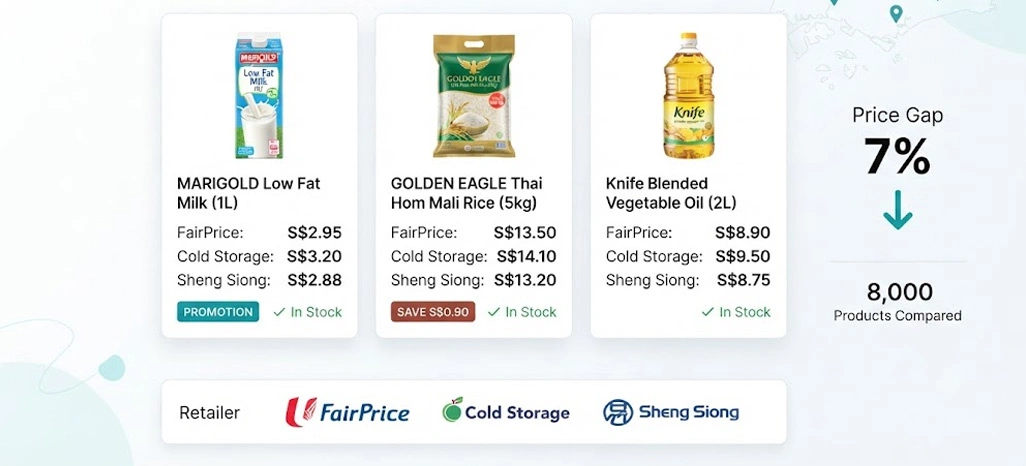
Competitive pricing can shift rapidly when retailers introduce promotions, adjust standard prices, or respond to market conditions. Businesses therefore need more than isolated product observations. They require organized information that allows pricing teams to compare multiple retailers using consistent attributes. Structured datasets can bring together product prices, discounts, brands, pack sizes, and availability so that meaningful differences can be identified across competing grocery channels.
Through Singapore Supermarket Price Monitoring, businesses can examine how frequently products change and where notable price gaps occur. For instance, if 8,000 comparable products are analyzed and the average difference reaches 7%, teams can investigate whether those gaps relate to promotions, pack sizes, positioning, or broader pricing strategies. This type of review strengthens Supermarket Competitor Analysis Singapore by transforming collected observations into comparable market information.
| Competitive Metric | Example Result |
|---|---|
| Comparable products | 8,000 |
| Average price difference | 7% |
| Categories evaluated | 35 |
| Discounted products | 18% |
| Review cycle | Weekly |
Frequent monitoring can also help identify products that consistently remain above or below competitor prices. Category managers may then prioritize these items for additional review instead of manually examining every product. Over time, historical records can reveal whether pricing differences are temporary promotional events or recurring competitive patterns.
Key benefits:
- Competitor price benchmarking
- Product-level comparisons
- Promotional pattern identification
- Category performance reviews
- Historical pricing evaluation
Better Product Comparisons For Smarter Retail Decisions
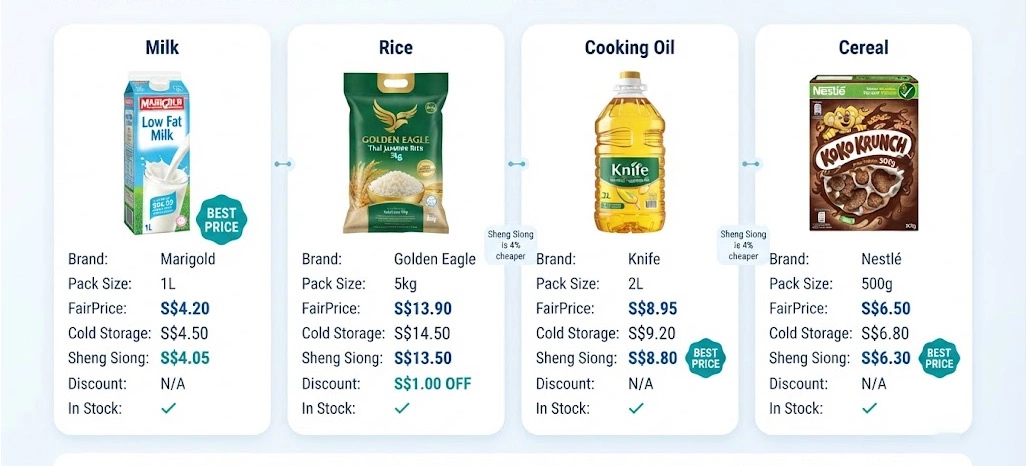
Product-level comparisons become more useful when businesses can evaluate similar items across retailers, categories, brands, and pack sizes. A structured dataset can standardize these attributes, making it easier to identify comparable products and understand how their prices differ. This creates a more practical foundation for evaluating competitive positioning and determining which products deserve additional attention.
Using Singapore Grocery Price Comparison, retailers can assess comparable products while considering factors such as listed price, discounts, package size, brand, and availability. This supports Grocery Product Monitoring Singapore by helping teams maintain visibility over important products and identify meaningful changes. At the same time, Singapore Retail Price Monitoring can help organize recurring observations across different product categories and retail channels.
| Product Comparison Area | Example Scope |
|---|---|
| Comparable SKUs | 12,000 |
| Categories covered | 40 |
| Pricing attributes | 5 |
| Promotion records | 2,500+ |
| Availability records | 10,000+ |
Consider a dataset containing 12,000 comparable products across 40 categories. Businesses could examine thousands of price and promotion records to identify products with notable differences. This information can support pricing reviews, assortment planning, promotional evaluation, and product-level benchmarking without depending entirely on manual research.
Key benefits:
- Product-level benchmarking
- Consistent attribute comparison
- Better assortment visibility
- Promotional evaluation
- Prioritized pricing reviews
How Retail Scrape Can Help You?
Retailers need dependable data collection when monitoring thousands of grocery products across multiple online sources. Singapore Grocery Price Data Scraping can help transform scattered retail information into structured datasets containing product names, prices, brands, categories, discounts, pack sizes, and availability.
We can support automated collection workflows designed around specific monitoring requirements. Data can be gathered at scheduled intervals, standardized across different sources, and prepared for reporting or analytical systems. This reduces repetitive manual research and helps businesses maintain a more organized view of changing grocery market conditions.
Key capabilities include:
- Automated collection from multiple grocery sources
- Product and category-level data extraction
- Scheduled monitoring for recurring updates
- Standardization of pricing and product attributes
- Scalable collection for large catalogs
- Structured datasets for analysis and reporting
Once collected, the information can be segmented by retailer, category, brand, or product. Grocery Pricing Intelligence Singapore can help teams interpret these structured records to evaluate pricing positions, promotional activity, and category-level movements. This supports practical decisions across pricing, assortment, competitive benchmarking, and retail strategy.
Conclusion
Consistent grocery market monitoring can provide valuable visibility into product prices, promotions, availability, and competitive movements. Singapore Grocery Price Data Scraping helps businesses convert frequently changing online retail information into structured datasets that can support recurring analysis, product comparisons, and informed pricing decisions.
When competitive information is organized at product and category levels, Grocery Competitor Price Analysis can help retailers identify pricing gaps, promotional differences, and recurring market movements. We can support scalable data collection workflows designed around specific business requirements. Connect with Retail Scrape today to build a reliable grocery pricing data solution for your business.