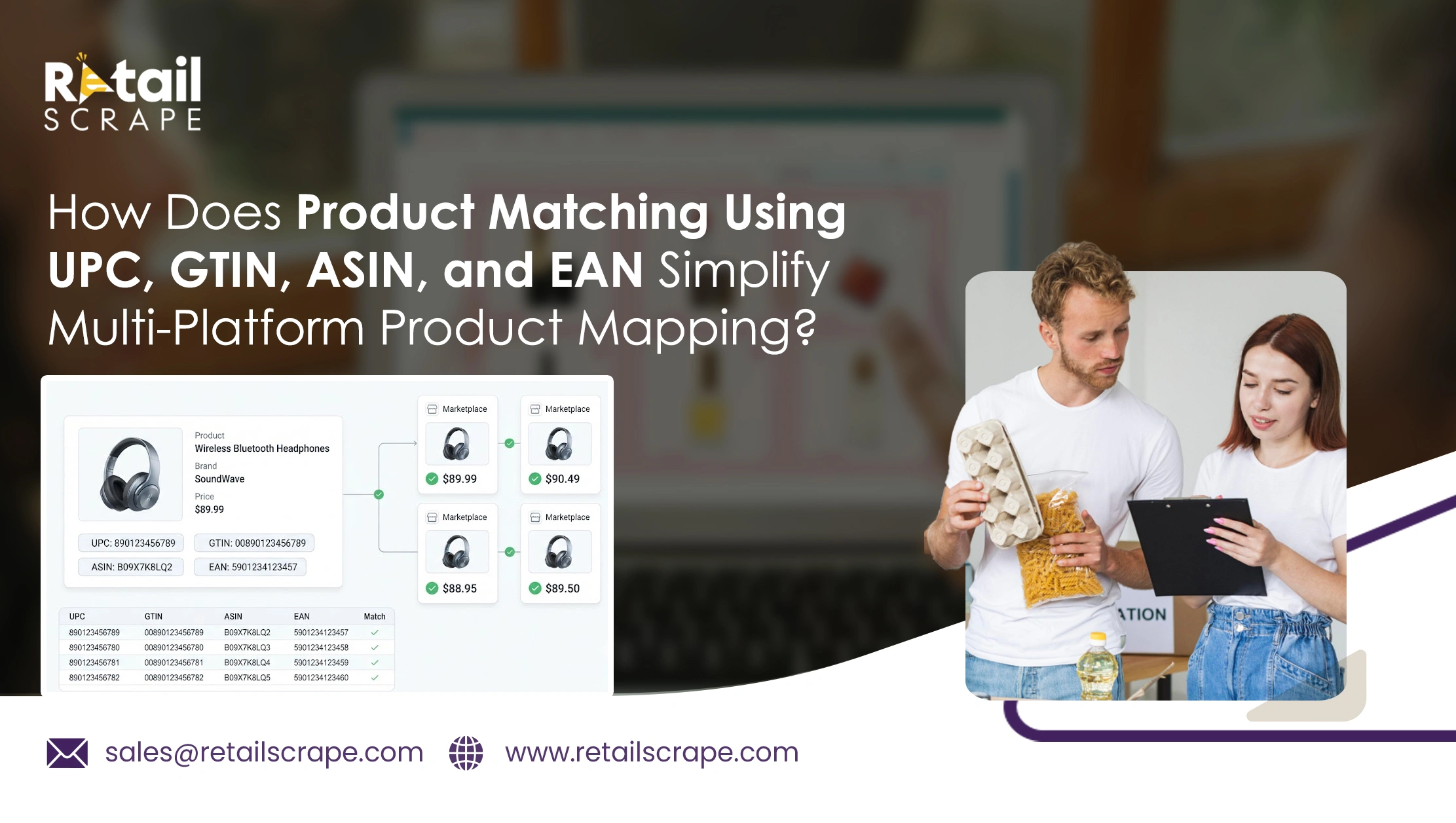
How Does Product Matching Using UPC, GTIN, ASIN, and EAN Simplify Multi-Platform Product Mapping?
Introduction
Retailers and brands often sell identical products across multiple marketplaces, yet inconsistent product titles, descriptions, and identifiers make accurate product mapping a difficult task. These inconsistencies create duplicate listings, inaccurate pricing comparisons, inventory mismatches, and reporting errors that directly impact operational efficiency.
Businesses that rely on clean product data require reliable methods to identify identical products regardless of naming differences across ecommerce platforms. Product Matching Using UPC, GTIN, ASIN, and EAN provides a standardized framework for connecting identical products listed across different online marketplaces. This structured approach also strengthens inventory synchronization, competitor monitoring, and pricing consistency across multiple retail channels.
Modern retail intelligence solutions increasingly combine AI-Powered Product Matching Using Product Identifiers with automated validation techniques to improve data quality while minimizing duplicate records. A well-structured product matching strategy ultimately enables better analytics, stronger pricing decisions, faster inventory reconciliation, and more reliable cross-platform retail intelligence for sustainable business growth.
Creating Accurate Product Connections Across Diverse Digital Marketplace Catalogs
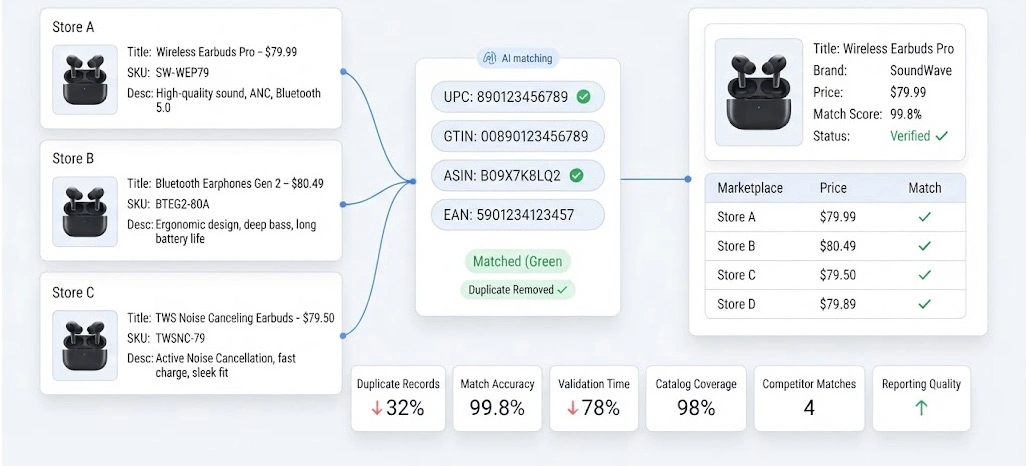
Retail businesses often encounter inconsistent product titles, incomplete descriptions, and varying catalog formats across online marketplaces. These differences make it difficult to identify identical products, leading to duplicate listings, pricing errors, and inaccurate reporting. Industry research indicates that nearly 30% of online retail catalogs contain inconsistent product information, creating operational inefficiencies and increasing manual verification efforts.
Businesses addressing these issues increasingly rely on Product Catalog Matching With UPC, GTIN, ASIN, and EAN Data to establish consistent product relationships without depending solely on textual information. When identical products appear under different names, competitor analysis becomes unreliable because pricing and assortment comparisons are no longer aligned.
Integrating ASIN and EAN Matching for Competitor Price Monitoring into retail workflows enables organizations to compare identical products across multiple marketplaces with greater confidence while reducing mismatched catalog records. This structured process also minimizes repetitive manual validation and improves overall data quality.
Businesses benefit from this approach by:
- Reducing duplicate product records.
- Improving product identification accuracy.
- Simplifying competitor catalog comparisons.
- Supporting consistent assortment analysis.
- Lowering manual validation workloads.
- Strengthening retail reporting quality.
Modern retail intelligence continues evolving through AI-Powered Product Matching Using Product Identifiers, allowing businesses to automate product recognition while improving mapping precision.
| Common Challenge | Business Benefit |
|---|---|
| Duplicate listings | Cleaner product catalogs |
| Naming inconsistencies | Higher matching accuracy |
| Manual verification | Faster processing |
| Reporting errors | Better retail insights |
Managing Large Retail Catalogs Through Intelligent Data Synchronization Processes
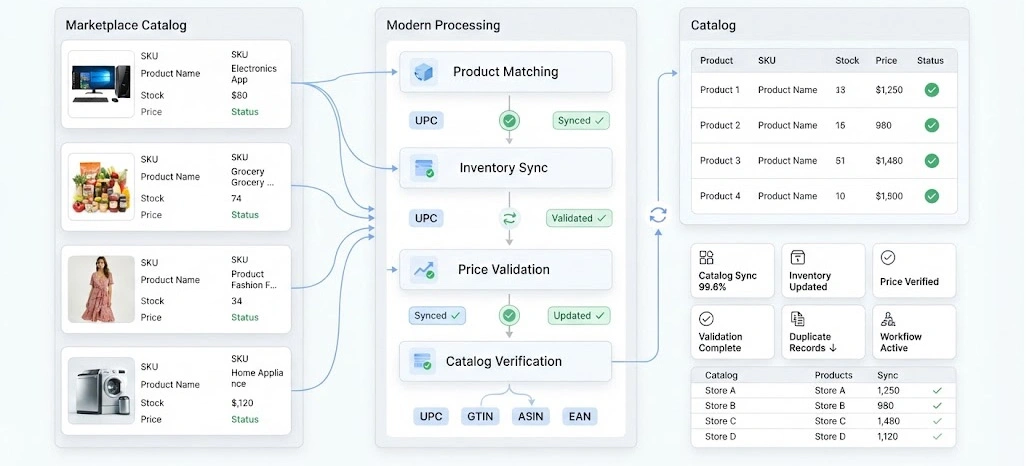
Managing thousands of products across multiple ecommerce platforms requires continuous synchronization to maintain consistency between inventory, pricing, and assortment data. As catalogs expand, manual reconciliation becomes increasingly inefficient.
Industry studies suggest businesses adopting automated catalog management reduce processing effort by up to 60%, allowing teams to focus on strategic retail operations instead of repetitive data corrections. Many organizations improve synchronization by implementing AI-Powered Product Matching Using Barcode and Product Identifiers within enterprise catalog workflows.
Large retail datasets change frequently as products are introduced, discontinued, or updated across marketplaces. Organizations increasingly implement Enterprise Product Matching Solutions Using Web Scraping APIs to automate catalog synchronization, reduce inconsistencies, and maintain accurate product relationships across numerous online retail channels.
Key operational advantages include:
- Faster catalog synchronization.
- Improved inventory consistency.
- Reduced manual processing.
- Better marketplace scalability.
- Reliable product validation.
- Streamlined operational workflows.
Automated validation significantly reduces mismatched records while supporting scalable product management. Businesses expanding into multiple marketplaces often incorporate Automated Product Matching Across Online Retailers to improve operational efficiency and maintain standardized catalog structures across continuously changing retail environments.
| Operational Focus | Expected Improvement |
|---|---|
| Catalog updates | Faster synchronization |
| Product consistency | Improved accuracy |
| Inventory visibility | Better coordination |
| Data management | Lower operational effort |
Achieving Reliable Competitive Pricing With Consistent Product Data Alignment
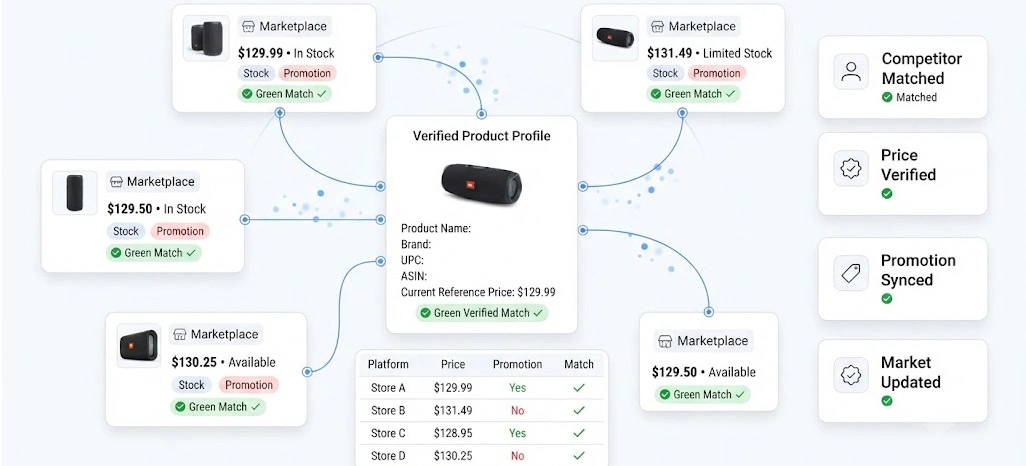
Reliable pricing intelligence depends on accurately identifying identical products across multiple ecommerce platforms. When products are incorrectly matched, competitor comparisons become misleading, affecting promotional planning, pricing strategies, and assortment decisions.
Industry research shows retailers using automated comparison technologies improve pricing response times by approximately 35%, enabling more responsive competitive decision-making. Organizations increasingly implement Cross-Platform Product Matching for Pricing Intelligence to maintain dependable comparisons across rapidly changing digital marketplaces.
Accurate product alignment also improves retail analytics by ensuring that promotions, stock availability, and pricing changes are measured against identical products rather than similar listings. Businesses increasingly strengthen pricing intelligence using Ecommerce Product Matching Using UPC and ASIN, helping analysts generate more reliable benchmarking and market performance evaluations across multiple sales channels.
Important business outcomes include:
- More reliable competitor analysis.
- Better promotional tracking.
- Improved pricing consistency.
- Faster market response.
- Enhanced retail reporting.
- Greater assortment visibility.
As ecommerce competition continues growing, organizations require dependable product relationships that support pricing optimization, assortment planning, and competitor monitoring. Standardized matching frameworks improve reporting accuracy while reducing comparison errors, enabling retailers to respond faster to market changes without increasing manual effort.
| Pricing Activity | Business Result |
|---|---|
| Competitor analysis | Accurate comparisons |
| Promotion evaluation | Better planning |
| Market benchmarking | Reliable insights |
| Pricing updates | Faster decision-making |
How Retail Scrape Can Help You?
Managing product information across multiple marketplaces requires more than simple catalog comparisons. By implementing Product Matching Using UPC, GTIN, ASIN, and EAN, businesses can build consistent product relationships across marketplaces while reducing duplicate records, pricing inconsistencies, and inventory synchronization challenges.
Our capabilities help organizations strengthen retail intelligence through:
- Match identical products across multiple ecommerce platforms.
- Reduce duplicate catalog records automatically.
- Improve inventory synchronization accuracy.
- Monitor competitor assortment changes efficiently.
- Support faster pricing comparison workflows.
- Deliver structured retail datasets for analytics.
These services are powered by advanced Web Scraping technologies that continuously collect structured retail information from multiple online sources while maintaining high data quality.
Combined with Automated Product Matching Across Online Retailers, businesses receive dependable product intelligence that supports catalog consistency, pricing optimization, assortment tracking, and operational decision-making across rapidly changing ecommerce environments.
Conclusion
Managing products across multiple online marketplaces becomes significantly easier when businesses adopt standardized identification methods instead of relying only on product titles. Implementing Product Matching Using UPC, GTIN, ASIN, and EAN improves catalog consistency, strengthens inventory accuracy, minimizes duplicate listings, and supports reliable competitor analysis for long-term retail operations.
Organizations looking to improve retail intelligence can further strengthen their workflows by adopting Product Matching for Retail Intelligence Platforms alongside automated data collection and validation processes. Contact Retail Scrape today to build reliable product matching solutions that improve marketplace visibility, operational efficiency, and competitive retail intelligence.
Effortlessly managing intricacies with customized strategies.
Mitigating risks, navigating regulations, and cultivating trust.
Leveraging expertise from our internationally acclaimed team of developers
Reliable guidance and assistance for your business's advancement