How Do Parallel Pipelines Power Food Delivery Marketplace Data Validation Across 1,200 Locations?
Introduction
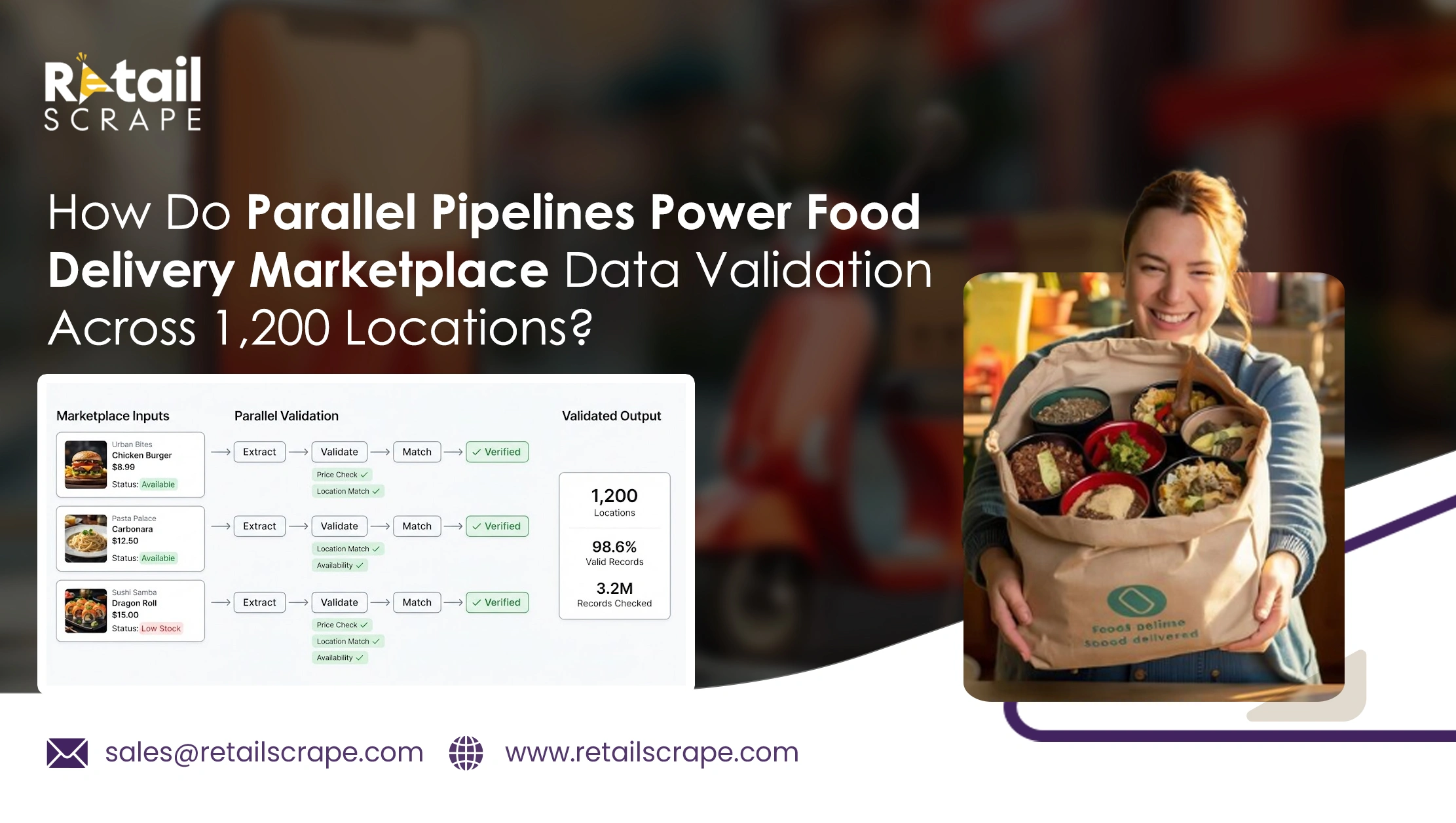
Food delivery marketplaces operate across thousands of restaurants, service zones, menus, and constantly changing prices. Maintaining accurate information across 1,200 locations requires structured collection, validation, and synchronization. Parallel processing allows businesses to manage high-volume information efficiently while reducing delays caused by sequential data workflows.
A well-designed Food Delivery Data Scraping Pipeline can collect restaurant menus, prices, ratings, delivery fees, availability, and location details from multiple sources. When these streams operate simultaneously, teams can compare incoming records, identify inconsistencies, and prioritize updates without waiting for one location to finish before processing another.
This approach makes Food Delivery Marketplace Data Validation more practical at scale because each location can be processed through dedicated validation stages. Businesses can continuously check missing fields, outdated prices, duplicate records, and availability changes, creating a dependable foundation for analytics, marketplace monitoring, and operational decision-making.
Parallel Pipelines Coordinate Validation Across Multiple Locations
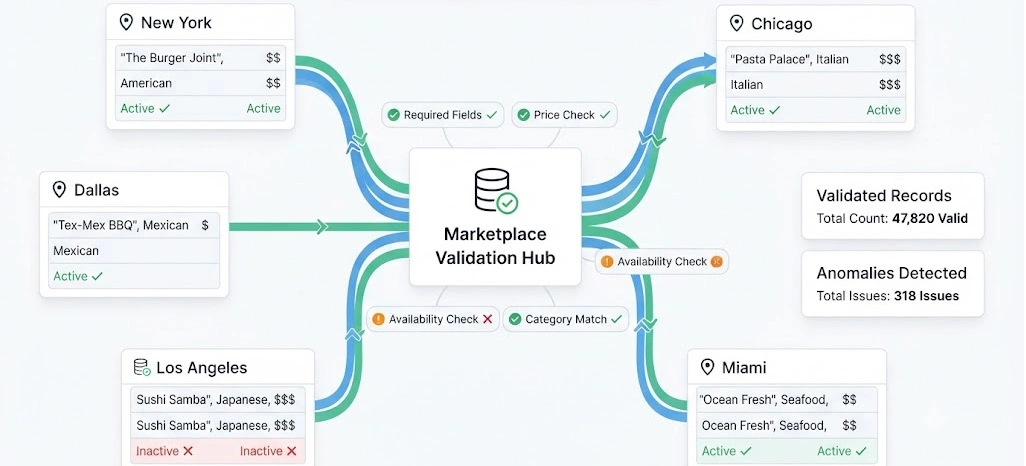
Large food delivery networks need a structured approach to process restaurant information from numerous locations simultaneously. Food Delivery Data Pipelines can divide large workloads into smaller processing tasks, allowing menus, prices, availability, and restaurant attributes to move through collection and validation stages without creating unnecessary processing queues.
A location-based architecture can assign individual workloads according to geographic coverage, restaurant volume, or update frequency. This approach supports Food Delivery Marketplace Validation by checking whether incoming records contain required fields, current values, consistent categories, and valid restaurant information. Teams can also identify anomalies before the data reaches reporting systems.
| Operational Area | Typical Validation Activity |
|---|---|
| Restaurant records | Check completeness |
| Menu information | Verify item attributes |
| Pricing records | Compare current values |
| Availability | Confirm active status |
| Location records | Check geographic consistency |
A Food Delivery Marketplace Data Validation Across Locations workflow can further standardize quality checks while allowing individual markets to retain their specific operating conditions. Businesses can process high-volume records simultaneously, helping reduce delays when several locations experience menu updates or pricing changes at the same time.
Teams can also structure processing around practical requirements such as:
- Prioritizing frequently updated locations
- Separating workloads by geographic region
- Applying consistent validation rules
- Flagging incomplete or duplicated records
- Scheduling recurring verification cycles
These processes create a more organized foundation for Food Delivery Data Intelligence, where verified records can support dashboards, operational analysis, trend monitoring, and business reporting. Instead of treating every location as an isolated dataset, parallel workflows create a connected structure for managing information at marketplace scale.
Regional Workloads Improve Consistency Across Marketplace Data
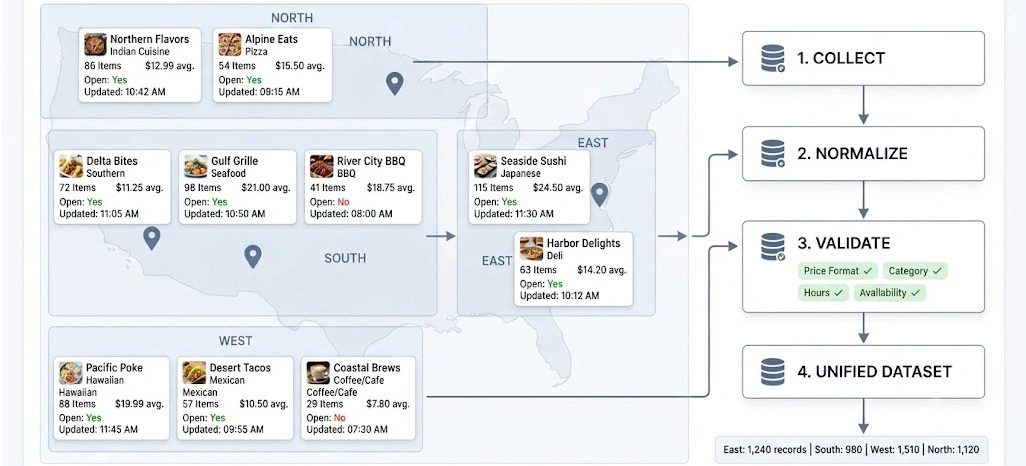
Food delivery platforms frequently experience regional differences because restaurants can independently change menus, operating hours, prices, delivery areas, and item availability. A Scalable Food Delivery Data Pipeline can divide these workloads by location while maintaining standardized processing rules, making it easier to manage large datasets without treating every market identically.
Restaurant information also requires frequent updates because item descriptions, categories, prices, and availability can change throughout the day. Through Restaurant Menu Data Scraping, businesses can collect structured restaurant-level information and route it through normalization and validation stages. This helps ensure that records follow consistent formats before being used for analysis.
| Regional Data Area | Quality Check |
|---|---|
| Restaurant details | Field completeness |
| Menu categories | Category consistency |
| Product attributes | Attribute accuracy |
| Operating hours | Schedule consistency |
| Delivery coverage | Service-area verification |
Parallel processing enables separate geographic workloads to operate at the same time. Parallel Data Processing for Food Delivery can reduce dependence on sequential execution, particularly when thousands of restaurant records require simultaneous extraction, comparison, normalization, and verification across different markets.
A well-organized regional workflow can support several operational activities:
- Processing locations according to update frequency
- Separating high-volume and low-volume markets
- Standardizing restaurant attributes
- Monitoring regional data changes
- Maintaining consistent output structures
Once regional datasets are standardized, businesses can compare marketplace conditions across areas more systematically. Food Delivery Competitor Analysis can use these structured records to examine differences in restaurant coverage, menu availability, pricing structures, delivery conditions, and service-area representation without relying on fragmented datasets from individual locations.
Automated Checks Strengthen Pricing And Availability Accuracy
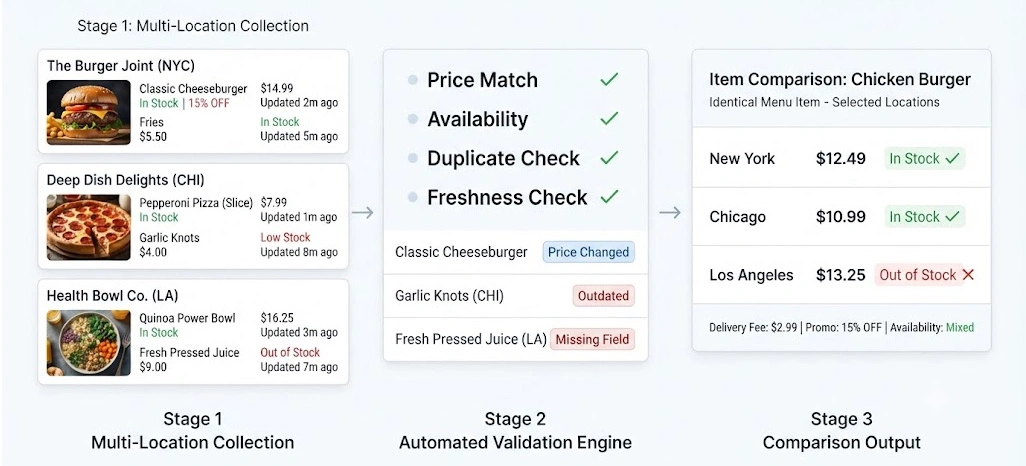
Prices and availability can change rapidly because of promotions, demand fluctuations, restaurant operations, inventory conditions, and marketplace updates. Food Delivery Data Scraping Across Multiple Locations helps collect these changes across geographic markets, while automated validation checks can identify missing fields, unusual values, duplicates, and outdated records before they reach analytical systems.
Pricing information requires particularly careful comparison because identical products may appear at different prices across restaurants, regions, or delivery platforms. Food Delivery Price Comparison Data can provide structured records for examining item-level differences, promotional changes, delivery charges, and regional pricing patterns while keeping information organized for recurring analysis.
| Data Category | Automated Check |
|---|---|
| Item price | Value comparison |
| Availability | Status verification |
| Product records | Duplicate detection |
| Restaurant data | Completeness check |
| Delivery information | Field consistency |
Availability monitoring can also help identify records that no longer reflect current marketplace conditions. A validation framework can compare newly collected information against previous records and flag significant changes for review. This makes recurring quality control more practical when thousands of restaurants are distributed across numerous service zones.
Businesses can organize these checks around several activities:
- Comparing current and previous records
- Detecting unexpected pricing changes
- Identifying unavailable menu items
- Removing duplicate entries
- Flagging incomplete restaurant information
For organizations developing a structured approach, How to Validate Food Delivery Data Across Locations can involve combining automated rules, standardized schemas, location identifiers, and recurring verification schedules. Such processes make large datasets easier to maintain while supporting reliable pricing analysis, marketplace reporting, demand studies, and operational planning.
How Retail Scrape Can Help You?
We support large-scale marketplace monitoring with structured extraction and validation workflows tailored to business needs. Across 1,200 locations, Food Delivery Marketplace Data Validation can help verify menus, pricing, availability, restaurant details, and location-specific data while reducing manual checks.
Key capabilities can include:
- Real-time collection of changing marketplace information
- Automated verification of important restaurant attributes
- Structured data delivery for analytics and reporting
- Location-specific processing for broad geographic coverage
- Identification of missing, duplicate, or inconsistent records
- Flexible workflows aligned with changing business requirements
By combining automated extraction with structured quality checks, teams can maintain datasets that are easier to review, update, and analyze. Store & Location Intelligence can organize regional information into structured datasets for market monitoring, operational planning, restaurant research, and location-based analysis. These workflows can also be adjusted as business requirements, geographic coverage, or validation frequencies change.
Conclusion
Managing marketplace information across 1,200 locations requires more than collecting large volumes of records. Businesses need systematic processes that identify inaccurate menus, changing prices, unavailable items, duplicate records, and location-level inconsistencies. Food Delivery Marketplace Data Validation can establish a structured quality layer between data collection and downstream analytics, helping teams work with more consistent information.
Parallel workflows make large-scale processing more organized by handling multiple locations simultaneously while maintaining standardized validation rules. Businesses can combine recurring checks with structured Food Delivery Marketplace Validation to support pricing analysis, reporting, forecasting, and marketplace monitoring. Contact Retail Scrape to discuss a customized data collection and validation workflow for your food delivery marketplace requirements.