How Can Category-Level Data Scraping for Market Analysis Guide Unlock Faster Insights Across E-Commerce?
Introduction
Modern e-commerce businesses generate enormous volumes of category-specific information every day. From pricing fluctuations and product assortment changes to customer preferences and inventory updates, every data point plays a role in shaping strategic decisions. A structured Category-Level Data Scraping for Market Analysis Guide provides organizations with an efficient way to collect, organize, and evaluate category-focused information from multiple online marketplaces.
Instead of relying on fragmented reports, businesses can continuously monitor changing market dynamics with greater speed and accuracy. Organizations also benefit from integrating Category Data Scraping for Market Analysis into their analytics workflows, allowing them to compare brands, product availability, seasonal demand, and promotional strategies across multiple platforms.
This supports better Competitor Category Analysis, helping businesses identify category leaders and performance gaps before making strategic investments. Industry reports indicate that data-driven retailers improve pricing efficiency by nearly 20% while reducing reporting time by over 40%, making automated category intelligence an increasingly valuable business asset.
Strengthening Pricing Strategies Through Organized Category Monitoring
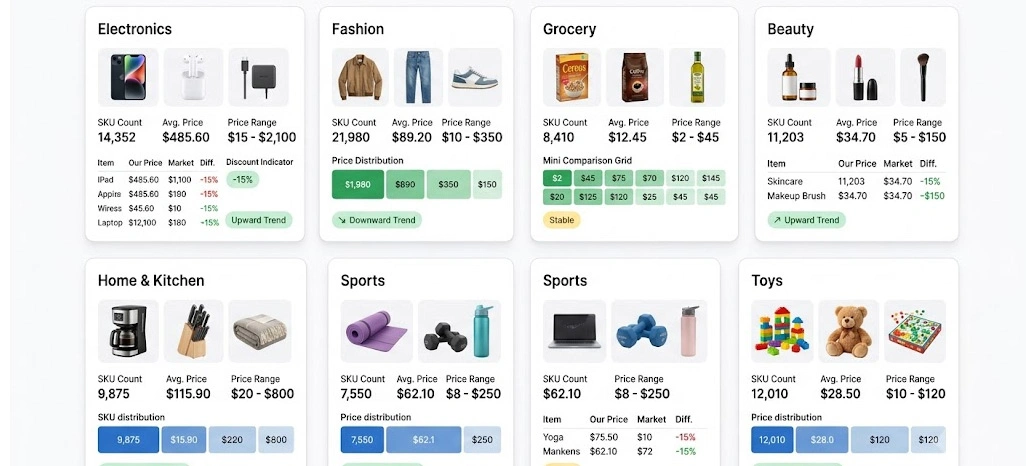
Businesses that operate across competitive online marketplaces need consistent visibility into changing pricing structures, product assortments, and promotional campaigns. Rather than depending on occasional manual observations, companies benefit from automated category monitoring that captures real-time market movements across multiple sellers.
This structured approach enables decision-makers to identify pricing gaps, monitor assortment changes, and recognize seasonal opportunities before competitors respond. Incorporating Ecommerce Category Data Scraping into daily analytics allows organizations to collect large-scale category information efficiently while maintaining data consistency.
When combined with Pricing & Assortment Analysis, businesses can compare discount strategies, stock availability, bundle offers, and promotional frequency across several platforms. Industry research indicates that organizations using automated category monitoring improve pricing response times by nearly 30%, while reducing reporting workloads by over 60%.
Category Pricing Performance Snapshot:
| Metric | Manual Monitoring | Automated Category Tracking |
|---|---|---|
| Price Update Frequency | Weekly | Hourly |
| Competitor Coverage | Limited | Extensive |
| Pricing Accuracy | Moderate | High |
| Reporting Time | 12 Hours | 2 Hours |
| Promotional Visibility | Partial | Comprehensive |
A reliable Category Pricing Analysis Dataset further strengthens planning by organizing product-level pricing information into standardized formats for reporting and forecasting. Instead of spending hours collecting data manually, teams can focus on evaluating trends, identifying high-performing categories, and optimizing merchandising decisions.
Turning Customer Feedback Into Smarter Business Decisions
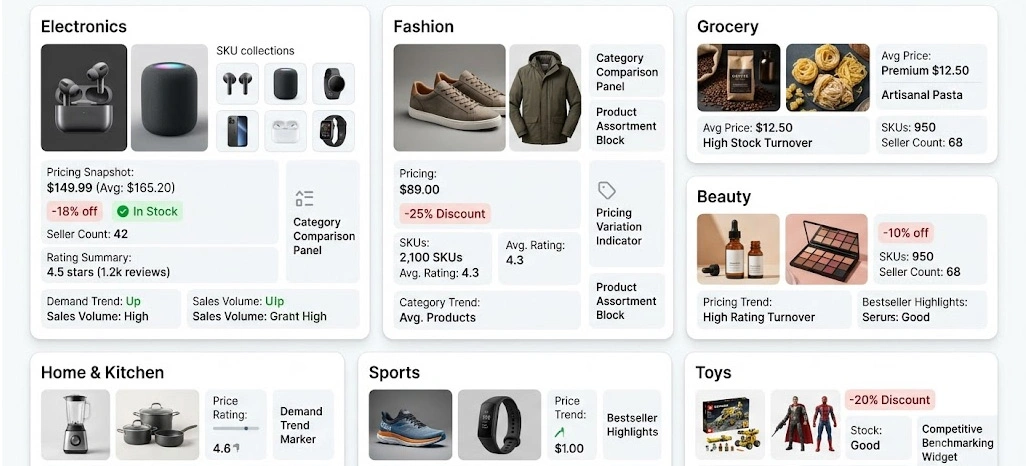
Customer behavior provides valuable insights that extend far beyond product reviews alone. Integrating Customer Sentiment Analysis with structured category monitoring enables organizations to identify recurring concerns, preferred product features, and emerging buying trends across multiple online marketplaces. Instead of reviewing isolated comments, companies obtain broader visibility into category-wide customer expectations that influence purchasing behavior.
Combining this approach with Market Analysis Data Scraping creates structured datasets that connect customer opinions with product performance, pricing changes, and competitive positioning. Businesses can also utilize Category-Level Market Analysis Using Web Scraping to continuously monitor category movements while maintaining accurate historical records for future planning.
Organizations using integrated customer intelligence often improve product optimization by approximately 25% while increasing customer satisfaction through faster response to changing preferences. Structured category intelligence simplifies demand forecasting, improves assortment planning, and supports evidence-based product development decisions.
Customer Intelligence Overview:
| Performance Indicator | Traditional Review | Data-Driven Review |
|---|---|---|
| Feedback Coverage | Limited | Broad |
| Trend Detection | Slow | Fast |
| Product Insights | Basic | Detailed |
| Decision Speed | Moderate | High |
| Category Visibility | Partial | Complete |
By analyzing customer expectations alongside evolving market conditions, retailers can make more confident strategic decisions, reduce uncertainty, and create stronger category performance that aligns with consumer demand while improving overall operational efficiency.
Expanding Market Visibility With Automated Category Intelligence
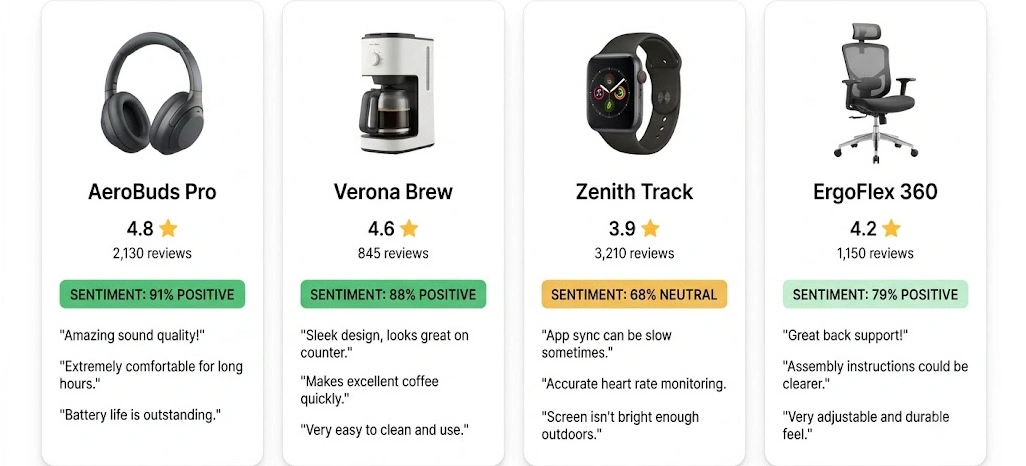
Modern e-commerce environments require businesses to process thousands of category-level data points every day. Manual research methods often fail to provide the speed, consistency, and scalability necessary for informed decision-making. Organizations increasingly rely on professional Web Scraping Services to automate large-scale category monitoring while maintaining high-quality structured datasets.
Automated collection improves operational efficiency by capturing pricing updates, inventory changes, promotional campaigns, and assortment variations across multiple marketplaces without continuous manual effort. In addition, businesses can strengthen long-term planning through a structured Category Performance Tracking Dataset, allowing teams to evaluate historical trends, compare category growth, and identify performance gaps across competitors.
The use of Competitive Intelligence Datasets further enhances strategic analysis by consolidating market information into standardized reporting formats that support forecasting, benchmarking, and executive decision-making. Industry studies suggest automated category monitoring reduces manual research activities by nearly 70% while significantly improving reporting accuracy and data reliability.
Category Monitoring Efficiency:
| Operational Metric | Manual Process | Automated Process |
|---|---|---|
| Data Collection Speed | Slow | Rapid |
| Product Coverage | Limited | Extensive |
| Update Frequency | Daily | Real-Time |
| Accuracy | Moderate | High |
| Resource Requirement | High | Lower |
Faster access to organized category information enables retailers to react quickly to changing market conditions, improve merchandising strategies, optimize operational planning, and strengthen competitive positioning. As digital marketplaces continue expanding, scalable automated data collection provides the foundation for sustainable business intelligence and long-term market success.
How Retail Scrape Can Help You?
Retail businesses require accurate category intelligence to respond quickly to changing market conditions and customer demand. By implementing a Category-Level Data Scraping for Market Analysis Guide, organizations can automate large-scale category monitoring while improving reporting accuracy and strategic planning.
Advanced analytics combined with E-Commerce Data Intelligence helps businesses convert raw marketplace information into meaningful business insights that support pricing, merchandising, and inventory optimization.
Our solutions help businesses:
- Automate large-scale marketplace monitoring.
- Track category trends in real time.
- Compare product assortments across competitors.
- Improve pricing visibility with structured reporting.
- Support merchandising and inventory planning.
- Deliver scalable data for business intelligence platforms.
Businesses also receive structured Competitive Intelligence Datasets that simplify category benchmarking, identify emerging opportunities, and strengthen long-term strategic planning across multiple digital marketplaces.
Conclusion
Businesses operating in highly competitive online markets require timely, reliable, and structured information to make informed decisions. A well-planned Category-Level Data Scraping for Market Analysis Guide enables organizations to improve category visibility, optimize pricing strategies, and strengthen long-term market planning through continuous data collection.
Integrating Competitive Intelligence Datasets into daily business operations supports smarter forecasting, stronger competitive benchmarking, and more confident strategic decisions. Ready to transform your category intelligence with scalable data solutions? Contact Retail Scrape today to build customized market intelligence for your business.
Effortlessly managing intricacies with customized strategies.
Mitigating risks, navigating regulations, and cultivating trust.
Leveraging expertise from our internationally acclaimed team of developers
Reliable guidance and assistance for your business's advancement