


How Pin-Code Level Grocery Pricing Intelligence Unlocks 30% Smarter Hyperlocal Pricing Across Local Markets?
Introduction
In today’s dynamic retail landscape, understanding the nuances of local markets has become critical for grocery businesses. Retailers are no longer just competing at a city or district level—they need precise insights at a pin-code level to optimize pricing strategies effectively. Pin-Code Level Grocery Pricing Intelligence provides the capability to capture granular pricing details across neighborhoods, enabling hyperlocal pricing decisions that can improve sales and profitability.
By Creating a Pin-Code Level Grocery Pricing Dataset, businesses can track variations in product pricing, promotional impacts, and inventory trends with precision. This approach allows companies to identify areas where competitive pricing adjustments can maximize revenue while reducing stock wastage.
Moreover, hyperlocal consumer behavior patterns often differ from one locality to another. Advanced data scraping models allow retailers to gather grocery price data across multiple pin codes, forming a robust Hyperlocal Market Intelligence Dataset. By analyzing this dataset, brands can tailor offers, optimize pricing strategies, and plan inventory with a level of accuracy that was previously unattainable.
Comparing Grocery Prices Across Local Neighborhood Markets

Understanding local pricing variations is crucial for retailers to remain competitive and improve profitability. Many businesses struggle to determine why some stores outperform others, even within the same city. By using Pin-Code Based Grocery Price Comparison, retailers can monitor differences in product pricing at the micro-level, helping them make targeted decisions for pricing, promotions, and inventory.
| Pin Code | Product Category | Current Price | Competitor Price | Price Variation % |
|---|---|---|---|---|
| 560001 | Dairy | ₹50 | ₹52 | -3.85% |
| 560034 | Snacks | ₹30 | ₹28 | +7.14% |
| 560045 | Beverages | ₹45 | ₹45 | 0% |
Analyzing this dataset reveals where competitive pricing adjustments are needed. Retailers can also track seasonal trends and promotional effects to identify areas with higher demand elasticity. Combining these insights with a Hyperlocal Grocery Pricing Analytics Platform enables stores to visualize patterns across neighborhoods, detect discrepancies, and adjust their strategies accordingly.
Moreover, the approach helps identify high-performing locations and underperforming regions. For example, a store in a high-demand area might require a slight price adjustment to maintain competitiveness, while another in a low-demand zone could benefit from localized promotions. With these actionable insights, businesses can optimize profitability while strengthening their presence across local markets.
Through this data-driven methodology, companies gain visibility into market dynamics and can make better decisions about pricing, product assortment, and targeted offers, all while maintaining operational efficiency.
Capturing Market Changes Through Live Price Monitoring Systems
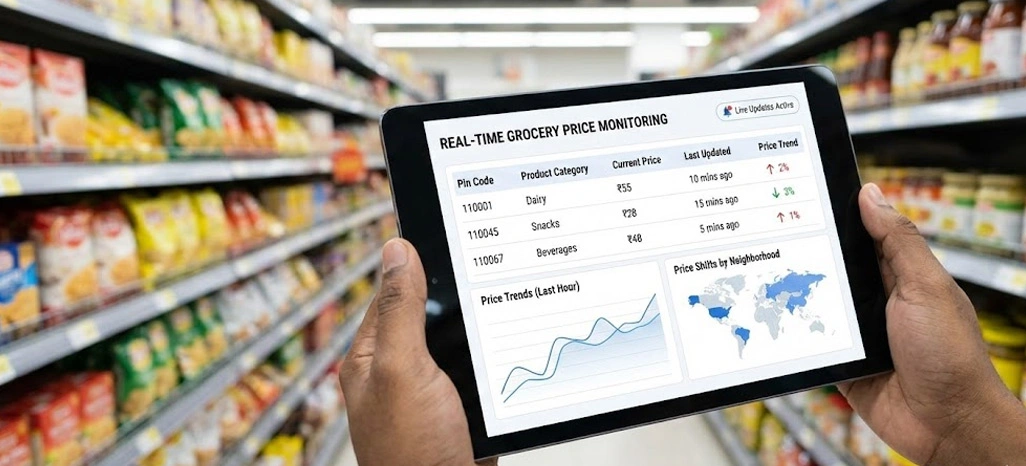
Timely and accurate pricing information is a major challenge in retail. By employing Real-Time Grocery Price Monitoring, businesses can track price changes, competitor strategies, and inventory shifts as they happen, which ensures proactive decision-making rather than reactive adjustments.
| Pin Code | Product Category | Current Price | Last Updated | Price Trend |
|---|---|---|---|---|
| 110001 | Dairy | ₹55 | 10 mins ago | ↑ 2% |
| 110045 | Snacks | ₹28 | 15 mins ago | ↓ 3% |
| 110067 | Beverages | ₹48 | 5 mins ago | ↑ 1% |
This approach allows retailers to allocate inventory efficiently, adjust local pricing, and launch promotional campaigns based on real-time data. Integrating these insights into a Pin-Code Level Grocery Price Monitoring framework provides actionable dashboards that capture price shifts across neighborhoods.
Additionally, combining live monitoring with historical trends creates a comprehensive dataset for predictive modeling. Retailers can anticipate demand surges, plan promotions, and minimize losses due to overstock or stockouts. For instance, if certain snack items are trending in a specific pin code, retailers can adjust pricing or inventory levels instantly.
Ultimately, adopting this methodology ensures competitive pricing, optimized inventory, and increased sales. Retailers can confidently make hyperlocal decisions while improving operational efficiency and customer satisfaction. Using a Hyperlocal Market Intelligence Dataset ensures every local decision is backed by accurate, location-specific insights.
Understanding Local Price Differences for Strategic Decision-Making

Retailers benefit significantly from analyzing neighborhood-level pricing data to drive targeted strategies. Analyzing Grocery Price Variations by PIN Code helps businesses detect disparities that affect revenue, identify profitable zones, and uncover opportunities for promotional campaigns or price adjustments.
| Pin Code | Product Category | Avg. Price | Competitor Avg | Variance % | Recommended Action |
|---|---|---|---|---|---|
| 400001 | Dairy | ₹52 | ₹54 | -3.7% | Increase Stock |
| 400023 | Snacks | ₹29 | ₹28 | +3.6% | Adjust Pricing |
| 400045 | Beverages | ₹47 | ₹45 | +4.4% | Introduce Offers |
By collecting this data using Pin-Code Wise Grocery Price Data Collection, retailers can identify areas with high price sensitivity, determine where promotions are likely to succeed, and allocate resources efficiently. The insights allow businesses to customize offers and pricing for each neighborhood, driving both revenue and customer loyalty.
Integrating the results into a Hyperlocal Grocery Pricing Analytics Platform allows companies to monitor performance, track trends, and optimize strategies continuously. Furthermore, this approach enhances decision-making accuracy by ensuring actions are based on reliable, location-specific insights rather than assumptions.
With these strategies, businesses can address the unique needs of every local market, optimize pricing structures, and improve operational efficiency. Data-driven insights create a competitive edge and help retailers sustain growth in hyperlocal markets.
How Retail Scrape Can Help You?
Retailers looking to implement hyperlocal pricing strategies need reliable and accurate data to inform decisions. Pin-Code Level Grocery Pricing Intelligence plays a critical role in driving informed retail strategies by providing a granular view of pricing trends across local markets.
With us, businesses can access:
- Customized datasets for each pin code.
- Historical pricing insights for trend analysis.
- Real-time competitor pricing alerts.
- Inventory demand forecasting at local levels.
- Seasonal and promotional trend analytics.
- Easy integration with existing retail dashboards.
By combining advanced scraping techniques with a Hyperlocal Grocery Pricing Analytics Platform, we ensure businesses have precise insights to create actionable strategies. Additionally, our Pin-Code Level Grocery Price Monitoring capabilities allow you to respond to market changes instantly, maximizing opportunities for profitability.
Conclusion
Pin-Code Level Grocery Pricing Intelligence empowers retailers to make smarter decisions at a hyperlocal scale. By leveraging detailed insights into pricing patterns and consumer behavior across pin codes, businesses can optimize strategies, enhance competitiveness, and boost revenue.
Integrating Local Grocery Price Data Scraping with existing retail systems ensures accurate, actionable insights for dynamic pricing and inventory management. Contact Retail Scrape now to transform your pricing decisions!