What is the Smart Way to Build a Grocery Item Database With UPC Codes Using 99% Accurate Data?
Introduction
India’s grocery ecosystem is rapidly evolving from fragmented offline records into centralized, insight-driven digital systems. Building an India FMCG Product Intelligence Database plays a critical role in unifying millions of SKUs with trusted identifiers, accurate visuals, and structured classifications—while maintaining near-perfect data accuracy at scale.
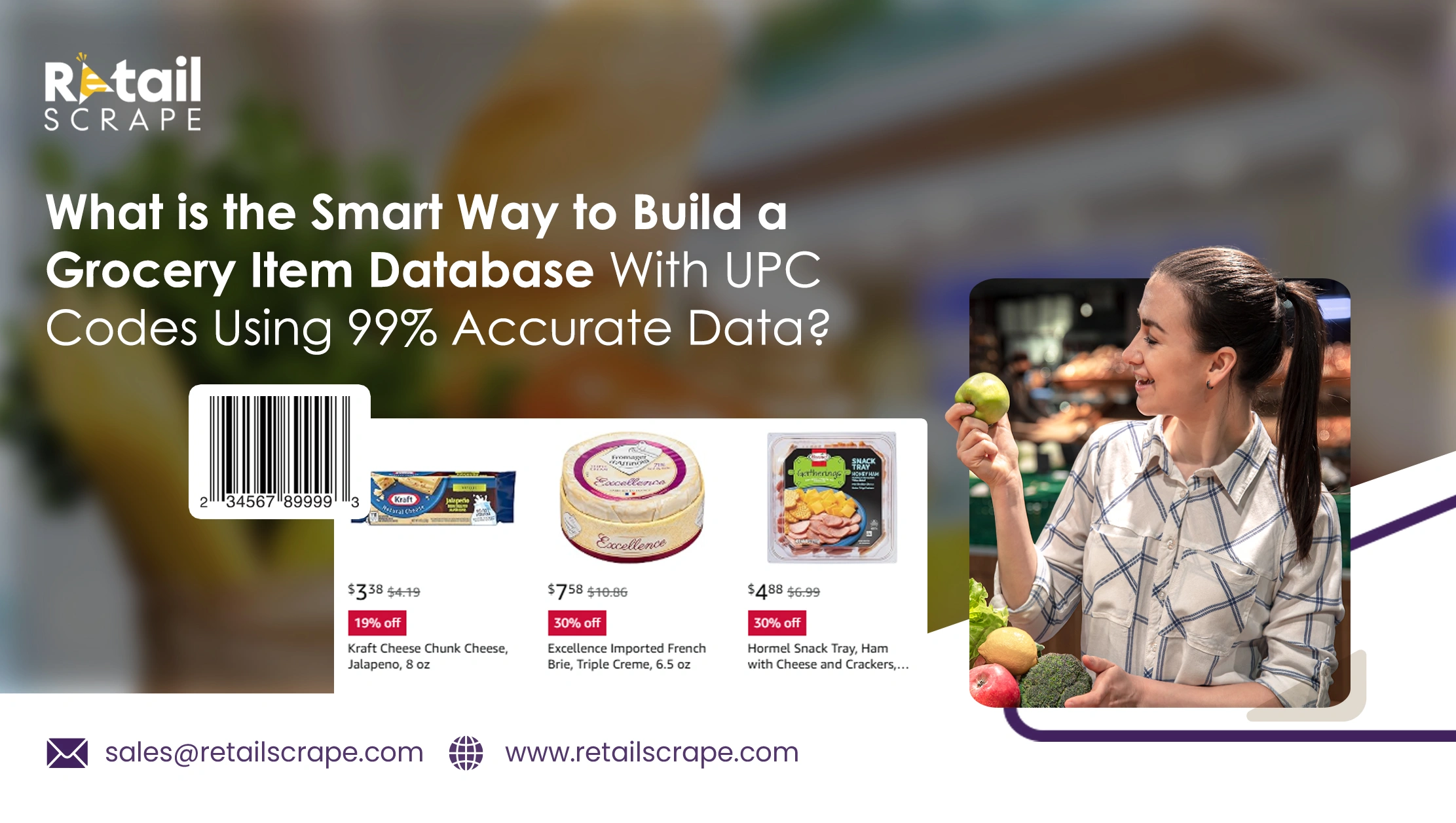
This is where structured data architecture becomes essential. A modern Grocery Item Database With UPC Codes acts as the foundation for building scalable retail intelligence. It enables businesses to unify barcode identifiers, packaging details, and visual references across stores and platforms. The smarter the structure, the faster businesses can respond to market shifts and consumer expectations.
When supported by Web Scraping Grocery Store Datasets, this approach helps capture real-time product changes, discontinued items, and newly launched SKUs without manual intervention. According to industry reports, Indian FMCG assortments change by nearly 18% annually, making static databases ineffective within months.
Resolving Product Data Fragmentation Across Retail Networks
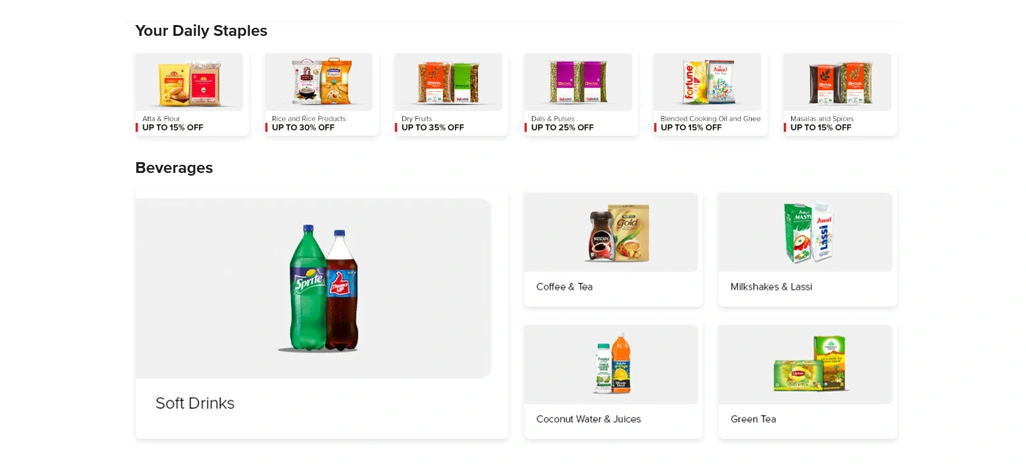
Indian grocery ecosystems suffer from extreme product-level fragmentation caused by inconsistent naming conventions, regional packaging variations, and platform-specific listings. The same SKU may appear multiple times under different descriptions, creating reporting inaccuracies and inventory confusion. Addressing this challenge begins with structured Indian Grocery Product Data Collection, which standardizes attributes such as brand, size, format, and barcode references across all data sources.
Automated collection frameworks reduce dependency on manual entry, which is prone to duplication and omission. When supported by a Grocery Scraper, retail systems can continuously capture updates from live grocery platforms, ensuring that product records remain synchronized with market reality. Industry observations indicate that automation-driven normalization can reduce duplicate SKU instances by over 30%, significantly improving catalog clarity.
Fragmented data not only disrupts analytics but also weakens downstream systems such as pricing intelligence and demand forecasting. Unified records allow businesses to accurately measure product performance without inflated counts or misaligned identifiers. This approach also simplifies onboarding new retail partners, as standardized records accelerate validation cycles.
Fragmentation Challenges vs Structured Resolution:
| Issue Area | Operational Impact | Resolution Outcome |
|---|---|---|
| Duplicate listings | Inflated analytics | Unified identifiers |
| Inconsistent attributes | Search mismatches | Attribute normalization |
| Manual updates | High error rates | Automated refresh |
| Regional variance | Reporting gaps | Location tagging |
By consolidating scattered product data into a single structured layer, businesses gain clearer visibility, improved accuracy, and stronger confidence in decision-making processes across merchandising and analytics teams.
Maintaining Visual And Category Consistency At Scale
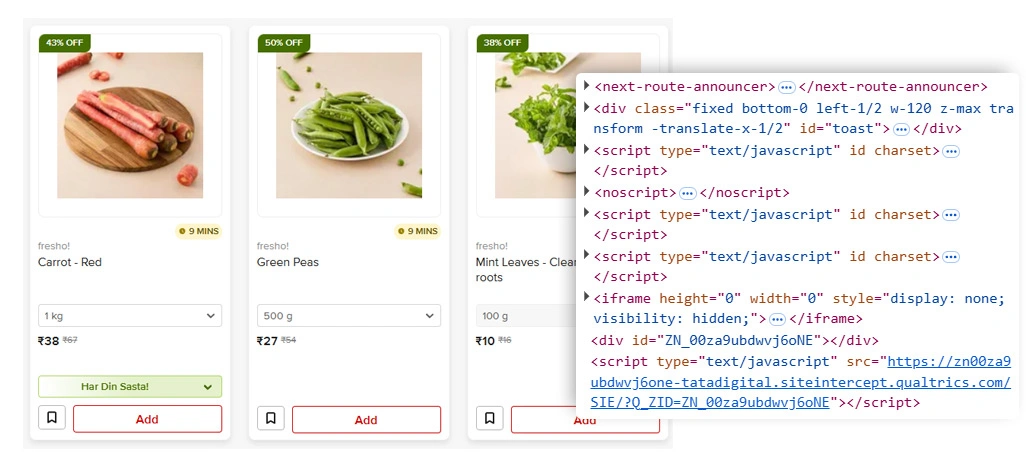
Visual accuracy plays a decisive role in maintaining trust across digital grocery ecosystems. Product images influence category classification, internal audits, and automated recognition systems. Establishing a reliable Indian Grocery Product Catalog With Images ensures that each SKU is visually validated and accurately classified.
Automation becomes critical when managing thousands of SKUs. A structured ingestion process powered by a Grocery Scraping API allows systems to fetch updated images and metadata directly from retail platforms. Studies show that visually verified catalogs reduce category misclassification by nearly 25%, improving both customer-facing accuracy and backend analytics reliability.
Visual consistency also strengthens machine-learning applications. When images are correctly mapped to identifiers, AI-driven tools such as shelf analytics and assortment planning operate with higher precision. This alignment minimizes false positives and enhances recognition accuracy across regions and store formats.
Impact Of Visual Alignment On Catalog Quality:
| Metric | Without Alignment | With Alignment |
|---|---|---|
| Category errors | High | Significantly reduced |
| Manual audit effort | Extensive | Minimal |
| Automation accuracy | Moderate | Improved |
| Catalog reliability | Low | High |
By maintaining visual and categorical consistency, grocery businesses create a dependable data layer that supports automation, analytics, and operational scalability without recurring manual interventions.
Improving Inventory Visibility Through Structured Extraction
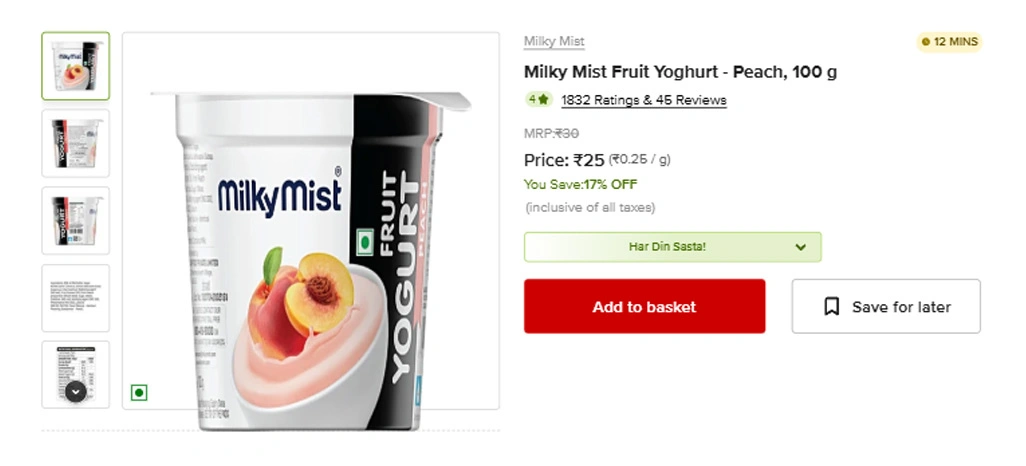
Inventory accuracy depends on how effectively product identifiers align with real-time availability signals. In India’s fast-moving grocery landscape, stock levels fluctuate frequently due to regional demand shifts, promotions, and supply constraints. Without structured monitoring, inventory insights quickly become outdated. This is where Indian FMCG Product Data Scraping becomes essential for sustaining relevance.
Through systematic Indian Grocery Inventory Data Extraction, businesses can link availability data to validated product records across multiple locations. Market analysis indicates that automated inventory pipelines improve replenishment accuracy by approximately 20–25%, enabling faster response to demand changes and reducing stockout risks.
Accurate inventory intelligence also supports strategic planning. When availability trends are mapped at SKU and regional levels, teams can identify underperforming areas, optimize distribution, and adjust assortment strategies proactively. This structured approach converts raw availability signals into actionable insights.
Inventory Intelligence And Business Impact:
| Inventory Signal | Strategic Benefit |
|---|---|
| Real-time stock status | Reduced stockouts |
| Regional availability | Targeted allocation |
| Pack size movement | Assortment optimization |
| Demand fluctuations | Faster response |
By aligning inventory signals with structured product data, businesses gain a real-time operational view that supports forecasting, supply chain coordination, and informed retail decision-making across competitive markets.
How Retail Scrape Can Help You?
We specialize in creating frameworks that support long-term data reliability while adapting to market changes. By implementing a Grocery Item Database With UPC Codes within a scalable architecture, businesses can eliminate duplication, improve visibility, and strengthen analytical confidence without increasing operational complexity.
What we delivers:
- Centralized product standardization across sources.
- Continuous validation of identifiers and attributes.
- Automated updates for product and packaging changes.
- Regional normalization for consistent reporting.
- Scalable architecture for expanding SKU volumes.
- Data-ready formats for analytics and BI tools.
By combining these capabilities with Extract Indian Grocery Product Catalog With UPC, we ensure your data foundation remains accurate, adaptable, and ready for advanced intelligence use cases.
Conclusion
A future-ready retail ecosystem depends on how effectively product identifiers, visuals, and availability signals are unified into a single intelligence layer. When structured correctly, a Grocery Item Database With UPC Codes becomes more than a repository.
By focusing on Linking UPC Codes With Grocery Product Images, businesses can reduce inconsistencies, strengthen automation, and improve trust in their data systems. Connect with Retail Scrape today and take the next step toward building a reliable, scalable, and insight-driven data foundation.